Definition
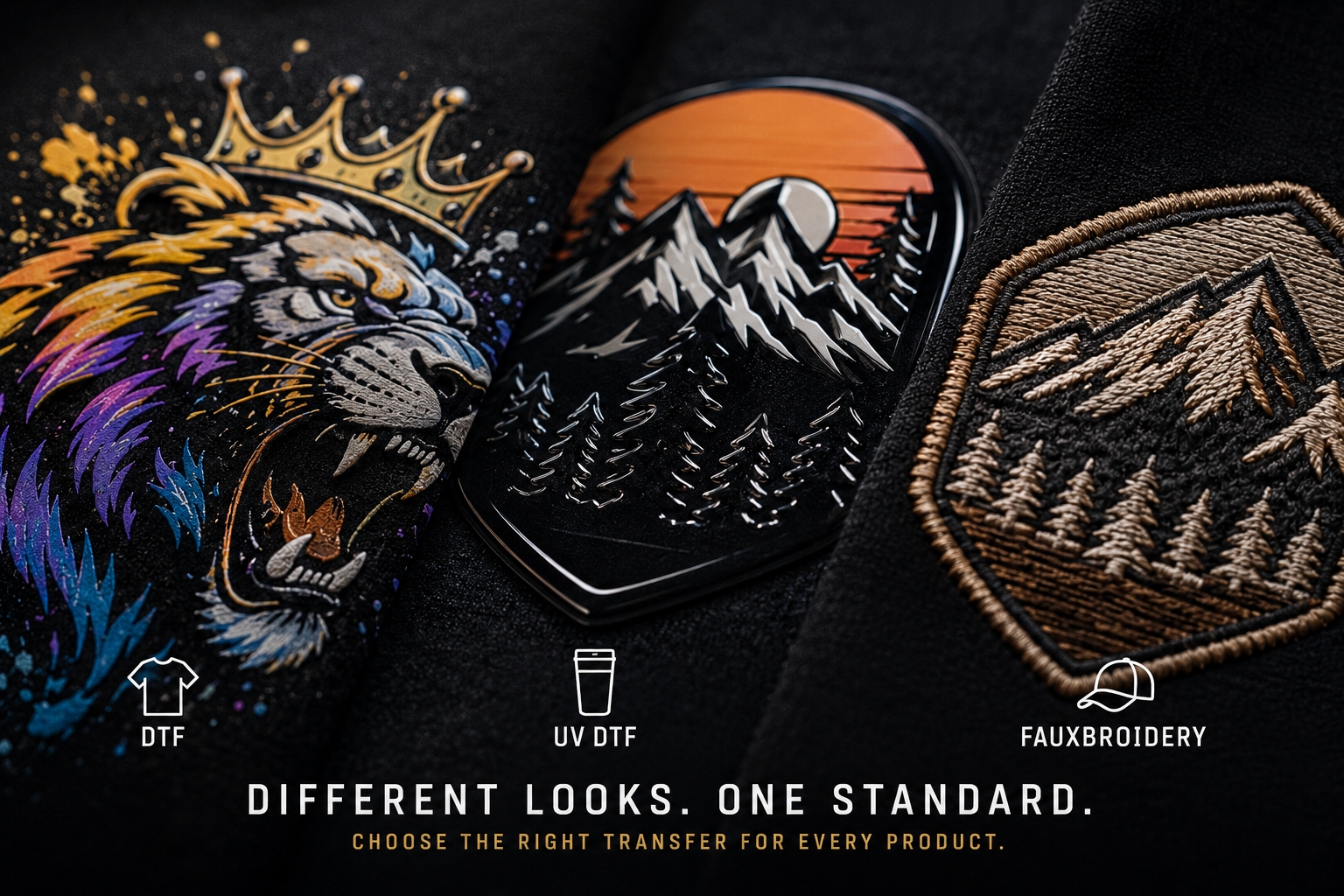
Specialty transfers are dimensional, raised, foiled, or specialty-substrate decoration components produced for professional decorators. The category covers raised UV patches, dimensional UV graphics, leatherette patches, luxury branding transfers, hard-good branding components, fauxbroidery, foil DTF, glow-in-the-dark, and crystal white transfers. Long Island DTF Printing produces the full specialty catalog at flat per-square-inch pricing with no minimums beyond standard production setup and 24-hour standard turnaround.
Specialty transfers sit one tier above standard DTF in the decorator menu. Where standard DTF answers the high-volume, full-color, fabric-agnostic decoration need, specialty transfers answer the premium upcharge tier, the hard-good decoration need, and the embroidery-style finish without thread. The two categories are structurally complementary. Standard DTF is the workhorse. Specialty transfers are the elevation. Most production decorators carry both.
What Counts as a Specialty Transfer
The defining trait of a specialty transfer is that it adds something beyond what a flat CMYK DTF print delivers. That something is one of four attributes.
- Dimension. Raised UV patches, dimensional UV graphics, luxury branding transfers, and fauxbroidery all build 0.3 mm to 0.8 mm of tactile surface height through layered UV cure passes.
- Specialty ink chemistry. Foil DTF uses a metallic foil layer. Glow-in-the-dark DTF uses phosphorescent pigments. Crystal white DTF uses a high-opacity white formulation for stretch and fine detail.
- Non-fabric substrate. UV DTF and hard-good branding components are formatted for glass, ceramic, metal, leather, acrylic, and sealed wood. Standard DTF is fabric-only. Specialty UV opens the rest of the decorator world.
- Material. Leatherette patches use a faux-leather substrate that replicates the look and feel of premium leather for hat panels, retail tags, and jacket inserts.
The Specialty UV Catalog at LIDTF
Every specialty line at LIDTF is produced in-house on a UV LED cure system or a polyamide-bonded DTF press. The catalog is integrated, not outsourced. Each line ships at a flat per-square-inch wholesale rate.
- Raised UV Patches : Full-color dimensional patches that reach 0.5 to 0.8 mm of tactile height without PVC tooling or embroidery digitizing.
- Dimensional UV Graphics : Large-format raised UV for drinkware, leather panels, and assembled hard goods.
- Leatherette Patches : Faux-leather patches engraved or UV-printed for hat panels, jacket inserts, and retail branding.
- Luxury Branding Transfers : Premium raised UV for retail apparel and corporate uniform programs.
- Hard-Good Branding Components : UV-printed branding for assembled products, packaging, and hard-good promotional items.
- Fauxbroidery : UV-cured stitch-texture transfers that replicate embroidery appearance without thread or digitizing.
- Foil DTF : Metallic gold and silver foil transfers for streetwear, event merch, and premium retail.
- Glow-in-the-Dark DTF : Phosphorescent pigment DTF for novelty SKUs, safety applications, and event merch.
- Crystal White DTF : High-opacity white formulation with added elasticity for stretch fabric and fine-detail work.
- UV DTF : Hard-good decoration on glass, ceramic, metal, leather, and rigid plastic. Peel-and-stick application, no heat press required.
Why Decorators Add Specialty Transfers to Their Menu
The economic argument for adding specialty transfers reduces to three numbers: margin per piece, perceived value at retail, and account differentiation.
- Premium upcharge margin. Where a standard DTF transfer retails at $15 to $25, a raised UV patch or luxury branding transfer commonly retails at $25 to $50 on the same garment. The dimensional finish reads as a luxury cue at first touch and the retail customer pays for that cue.
- Account differentiation. A decorator offering only standard DTF competes on price. A decorator offering raised UV, fauxbroidery, foil, and leatherette in addition to standard DTF competes on capability. The second pricing structure protects margin.
- Hard-good revenue. UV DTF and hard-good branding components let a decorator quote tumblers, mugs, journals, jacket panels, and assembled product programs without sourcing a separate vendor. The consolidation reduces operational overhead and captures margin previously routed to a third party.
How Specialty Transfers Differ from Standard DTF
Standard DTF is the workhorse. It bonds polyamide adhesive into fabric fibers so the print becomes part of the garment after a single heat press cycle. It runs at $0.06 per square inch with no minimum. It supports cotton, polyester, and most blends. It is the default answer for full-color apparel decoration at any volume.
Specialty transfers extend that foundation in specific directions. Raised UV adds tactile dimension. Fauxbroidery adds embroidery-style stitch texture without digitizing. Leatherette adds a premium material substrate. Foil adds a metallic finish. Glow adds a phosphorescent effect. Crystal white adds elasticity and fine-detail opacity. UV DTF adds hard-good compatibility. Each line answers a use case that standard DTF cannot reach.
For the standard DTF construction reference see What Are DTF Transfers. For the raised UV deep dive see What Are Raised UV Patches. For the fauxbroidery deep dive see What Is Fauxbroidery. For the dimensional technology reference see Raised Dimension Explained.
Production Process Overview
Every specialty UV line shares the same core production pipeline. CMYK pigment plus a white channel jets onto a substrate or transfer film. UV LED arrays cure the ink instantly. For dimensional lines, the print head returns for additional cure passes that build layered relief. Final cure locks the polymer into a hard, chemically resistant film. Quality control inspects every order before pack-out.
There is no digitizing step, no mold tooling, no thread file, and no minimum beyond standard production setup. This is the structural reason specialty UV displaces PVC patches and short- to mid-run embroidery for full-color and gradient artwork.
How to Order Specialty Transfers
Every specialty UV product page accepts the same file ingest as standard DTF: PNG, PDF, AI, EPS, SVG at 300 DPI in sRGB. Upload, choose dimensions and quantity, and submit. Most orders enter production within hours and ship on a 24 to 48 hour timeline. Decorators new to specialty UV typically start with the Specialty Specimen Kit.
- Order the Specialty Specimen Kit ($19) to receive labeled physical samples of every specialty UV line with a printed spec sheet.
- Browse the Specialty UV catalog and select the line that fits the project.
- Upload artwork, confirm size and quantity, and submit. Most production enters the queue within hours of the order being placed.
- Re-order the same artwork at the same per-square-inch rate for repeat client accounts. There are no volume tiers that reset.
Related Reference
- Specialty UV Catalog : Full lineup of every specialty UV product.
- What Are Raised UV Patches : The dimensional patch deep dive.
- What Is Fauxbroidery : UV-cured embroidery-style transfer reference.
- Raised Dimension Explained : The production chemistry behind dimensional UV.
- What Are DTF Transfers : The standard DTF foundation that specialty transfers build on top of.