Definition
How UV Printing Works describes the photopolymer chemistry behind UV DTF, raised UV patches, and dimensional UV graphics. UV-curable acrylate ink (liquid monomer plus oligomer with embedded photoinitiators and pigment) cures instantly under 365 to 405 nanometer UV LED light, transforming from liquid to solid plastic in milliseconds. No solvent evaporation, no thermal cure, no off-gassing.
UV printing replaces solvent or aqueous inks with photopolymer chemistry. The ink is a liquid monomer plus oligomer blend with embedded photoinitiators and pigment. While in the cartridge and on the printhead, it stays liquid. The instant a UV LED array crosses the printed droplet, the photoinitiators trigger a chain-reaction polymerization. Liquid becomes solid plastic in milliseconds.
The class of resin used in production at Long Island DTF is a UV-curable acrylate. Acrylates are favored over epoxies for transfer work because they cure faster, accept pigment loading without losing clarity, and stay flexible enough to survive heat pressing onto fabric without cracking. The cure mechanism is radical polymerization initiated by 365 to 405 nanometer UV LED light. There is no solvent evaporation, no thermal cure step, and no off-gassing once the cure is complete.
The cure step
On a UV LED cure system the cure happens inline. The printhead lays down a droplet, the carriage moves a few millimeters, and a UV LED array directly behind the printhead hits that droplet with focused 385 to 395 nanometer light. Surface cure is complete before the next pass. Full through-cure happens within the same pass or the immediately following pass. Because the cure is light-driven rather than heat-driven, the printer can deposit ink onto temperature-sensitive substrates including PVC, acrylic, leatherette, and powder-coated metal without warping or scorching.
Why UV enables raised output
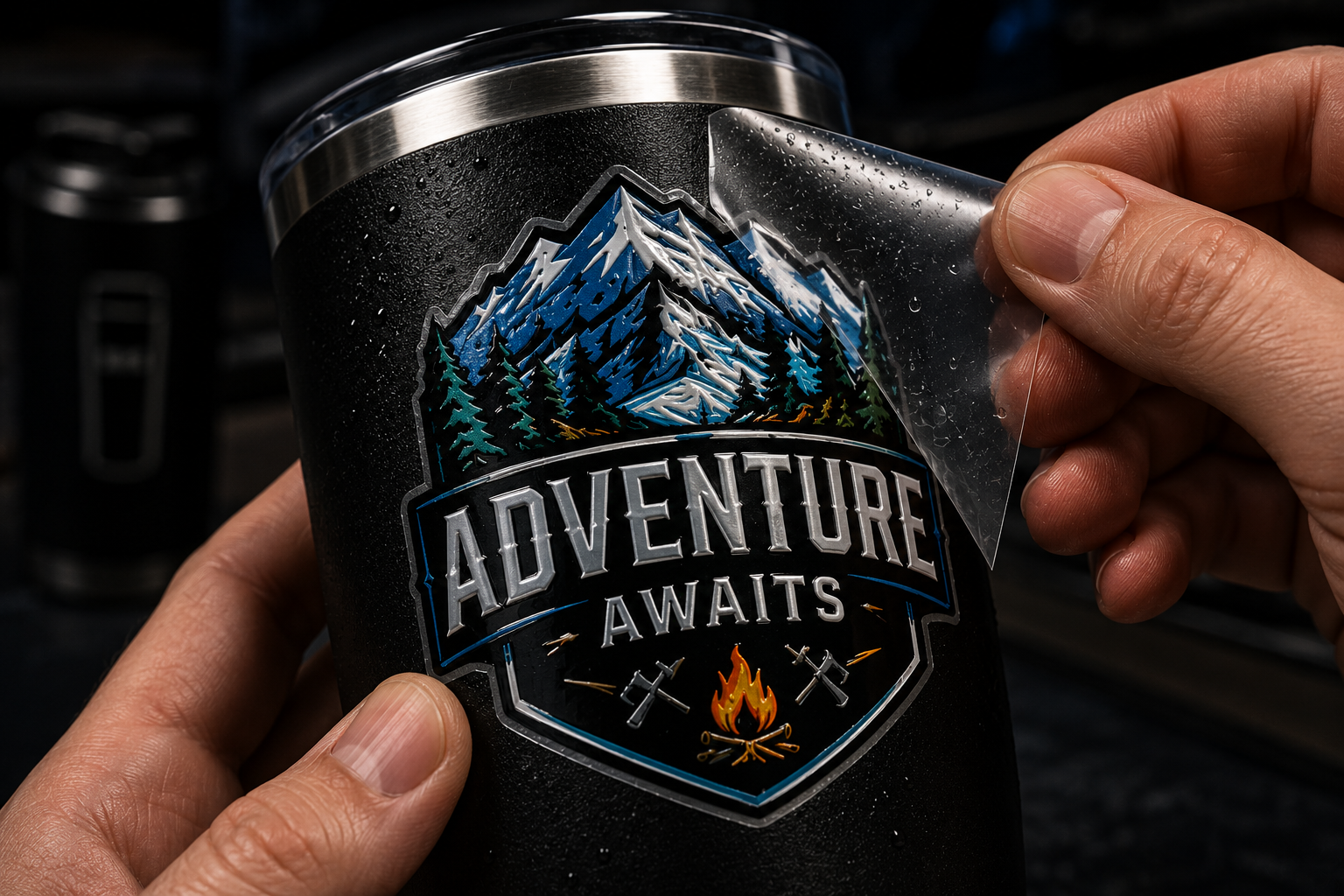
Aqueous and solvent inks dry by evaporation. As the liquid carrier leaves, the deposited film loses volume. You cannot build height by stacking layers because each layer collapses as it dries. UV ink does not lose volume on cure. The droplet you jet is the droplet you keep. Stack 10 cure passes on top of each other and you get roughly 10 times the height. This is the core mechanism behind raised UV patches and dimensional UV graphics.
Cure Chemistry Spec
- Resin class: UV-curable acrylate, low-yellowing formulation.
- Cure source: UV LED cure system, 385 to 395 nm.
- Cure time: Sub-second per pass, fully solid on exit.
- VOC profile: Near zero. No evaporative solvents in the formulation.
Substrate adhesion
UV ink adheres mechanically and chemically. On porous substrates like leatherette or unfinished wood, the liquid monomer wicks slightly into surface pores before cure, then polymerizes in place. On non-porous substrates like glass, anodized metal, acrylic, and powder coat, a primer or adhesion promoter is applied first. The primer creates a chemical bridge between the inert substrate surface and the cured acrylate. Without the primer, cured UV ink can be scraped off non-porous surfaces with a fingernail. With it, the bond passes ASTM D3359 tape-test adhesion at the highest classification on most rigid surfaces.
Transfer and applique applications
For garment work, UV ink is printed onto a release film or backing layer. The cured stack peels off as a finished applique that can then be heat-pressed onto fabric using a separate adhesive layer. This is how raised UV patches and luxury branding transfers are produced. The UV side handles the print quality and the dimension. A heat-activated adhesive added underneath handles the garment bond. The decorator never has to manage UV chemistry, only standard heat press application.