Definition
UV DTF transfers use ultraviolet-cured acrylate inks printed onto transfer film, designed for hard, non-porous surfaces like glass, ceramic, metal, leather, and rigid plastics. Unlike standard DTF which uses thermal adhesive on fabric, UV DTF bonds via pressure-applied cure and does not require a heat press for most applications. Long Island DTF Printing produces UV DTF transfers and dimensional UV products at flat per-square-inch wholesale pricing.
UV DTF is the rigid-substrate counterpart to standard fabric DTF. The acronym is the same (direct-to-film) but the chemistry is fundamentally different. Where standard DTF relies on thermoplastic polyamide adhesive that penetrates fabric fibers, UV DTF relies on UV-cured acrylate ink that polymerizes under LED light during the print cycle. The cure chemistry creates a permanent bond that mechanically locks into the substrate surface. The result is a hard, chemically resistant decoration that holds through dishwasher cycles and chemical cleaning on the rigid surfaces it is designed for.
How UV DTF Differs From Standard DTF
The two products share a name and a transfer-film format. They do not share chemistry, application method, or substrate range.
What Surfaces UV DTF Bonds To
UV-cured acrylate cures into a hard polymer that locks mechanically into non-porous surfaces and chemically anchors through a pressure-activated adhesive layer. The bond is permanent under normal use and survives dishwasher and chemical cleaning cycles on the substrates designed for it.
Works Well
- Glass (drinkware, bottles, vases)
- Ceramic (mugs, tiles, plates)
- Stainless steel and anodized aluminum
- Powder-coated metal
- Acrylic, polycarbonate, ABS plastic
- Sealed wood and bamboo
- Leather and leatherette
- Slate, stone, polished concrete
Does Not Work
- Silicone tumblers and bands
- Untreated polyethylene
- Untreated polypropylene
- Stretch fabric (use standard DTF)
- Cotton and woven textiles
- Fluoropolymer-coated surfaces
How UV DTF Is Applied
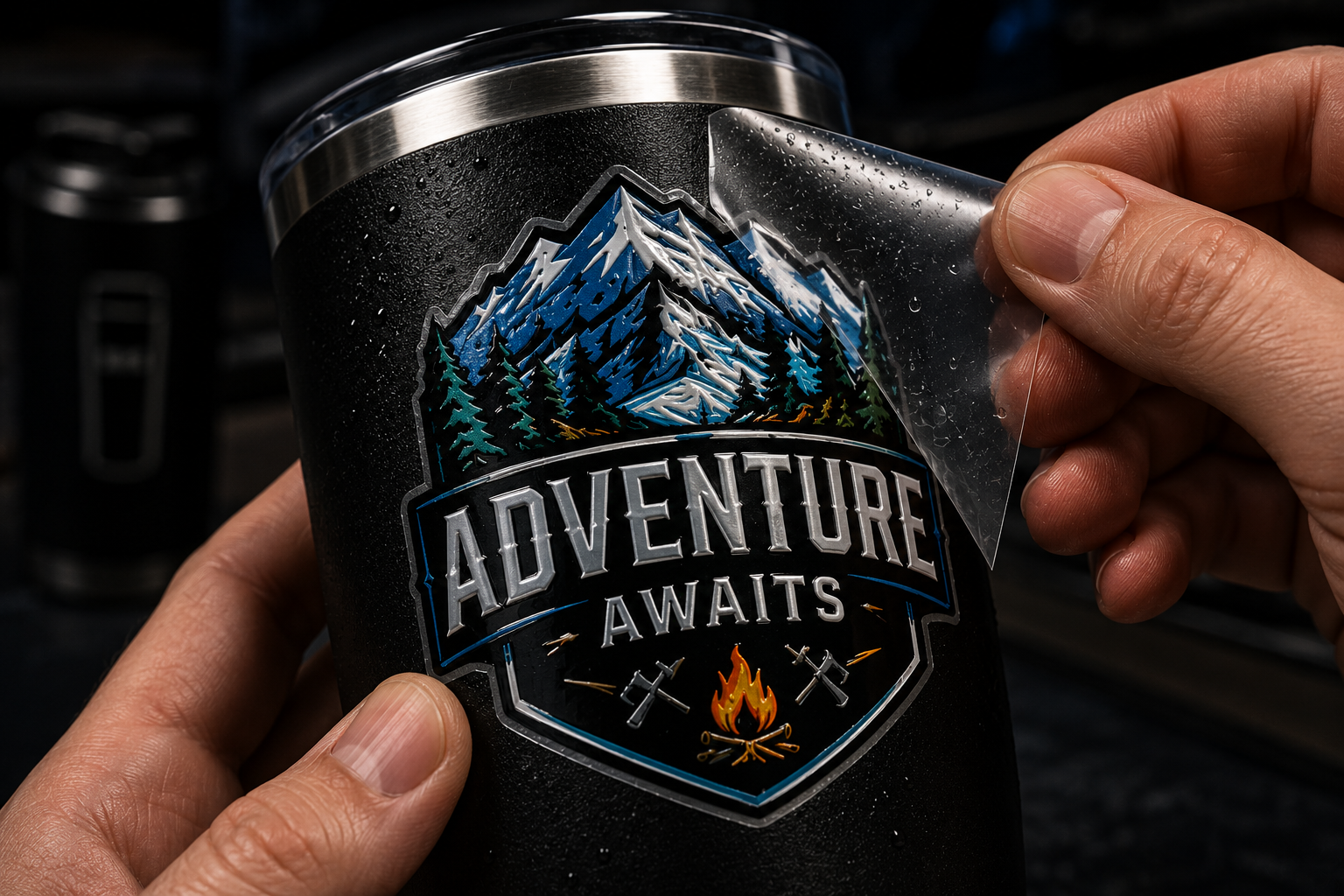
The standard UV DTF transfer arrives as a sandwich: a printed acrylate film with a clear adhesive backing on one side and a protective application tape on the other. Application is a three-step process.
- Peel the bottom release liner to expose the adhesive face.
- Position the transfer onto a clean, room-temperature substrate and burnish firmly across the full surface with a squeegee or roller.
- Slowly peel the top application tape away at a shallow angle, leaving the printed acrylate bonded to the substrate.
No heat press is required for most applications. Some hard-good branding components benefit from a low-temperature heat assist, around 180 to 200 F, to accelerate full bond on metal and coated surfaces. Apparel-grade UV products like raised UV patches and luxury branding transfers use a standard heat press because their backing is engineered to bond to fabric.
Dimensional UV Products at LIDTF
Long Island DTF Printing operates a UV LED cure press capable of layered cure passes. By repeating the print-and-cure cycle, the press builds 0.3mm to 0.8mm of tactile surface height in full-color graphics. The result is a family of dimensional UV products that share the UV chemistry but vary by substrate and format.
- Raised UV Patches. Apparel-grade dimensional patches with heat-press backing.
- Dimensional UV Graphics. Large-format raised graphics for drinkware, leather panels, and assembled hard goods.
- Leatherette Patches. UV-printed dimensional decoration on faux leather substrates.
- Luxury Branding Transfers. Premium raised UV for retail apparel and corporate uniform programs.
- Fauxbroidery. UV-cured stitch-texture transfers that replicate embroidery without thread or digitizing.
- Hard-Good Branding Components. Press-on UV decoration for assembled product lines and rigid substrates.
Limitations to Know
UV DTF is the wrong product for stretch fabric. The cured acrylate is a hard plastic film that cannot accommodate the dimensional strain of cotton jersey, performance polyester, or spandex blends. Apply UV DTF only to substrates that hold their shape under load. For decoration on apparel that needs to flex, use standard DTF or one of the apparel-grade UV products engineered specifically for fabric.
How to Order UV DTF at LIDTF
Long Island DTF Printing prices UV DTF and the specialty UV product family at flat per-square-inch wholesale rates. Most specialty UV lines carry a 10-unit production minimum to cover press setup. There are no digitizing fees, no tooling fees, and no volume tiers above the minimum. Per-square-inch pricing stays flat from order one to order one thousand.
- File formats. PNG with transparent background preferred. PDF, AI, EPS, SVG accepted. 300 DPI at final print size.
- Turnaround. 24 to 48 hours for production from order placement.
- Specimen kit. The Specialty Specimen Kit ships physical samples of every specialty UV line for press-side reference.
Related Reference
- How UV Printing Works : Acrylate chemistry, LED cure, and substrate adhesion.
- Raised Dimension Explained : How layered cure passes build 0.5mm to 0.8mm of tactile height.
- Specialty UV Catalog : Full lineup of dimensional UV products at LIDTF.
- What Are DTF Transfers : Standard fabric DTF reference.
- Dimensional UV Graphics : Order large-format raised UV for drinkware and hard goods.